
Searching Briscoe County Civil Dockets
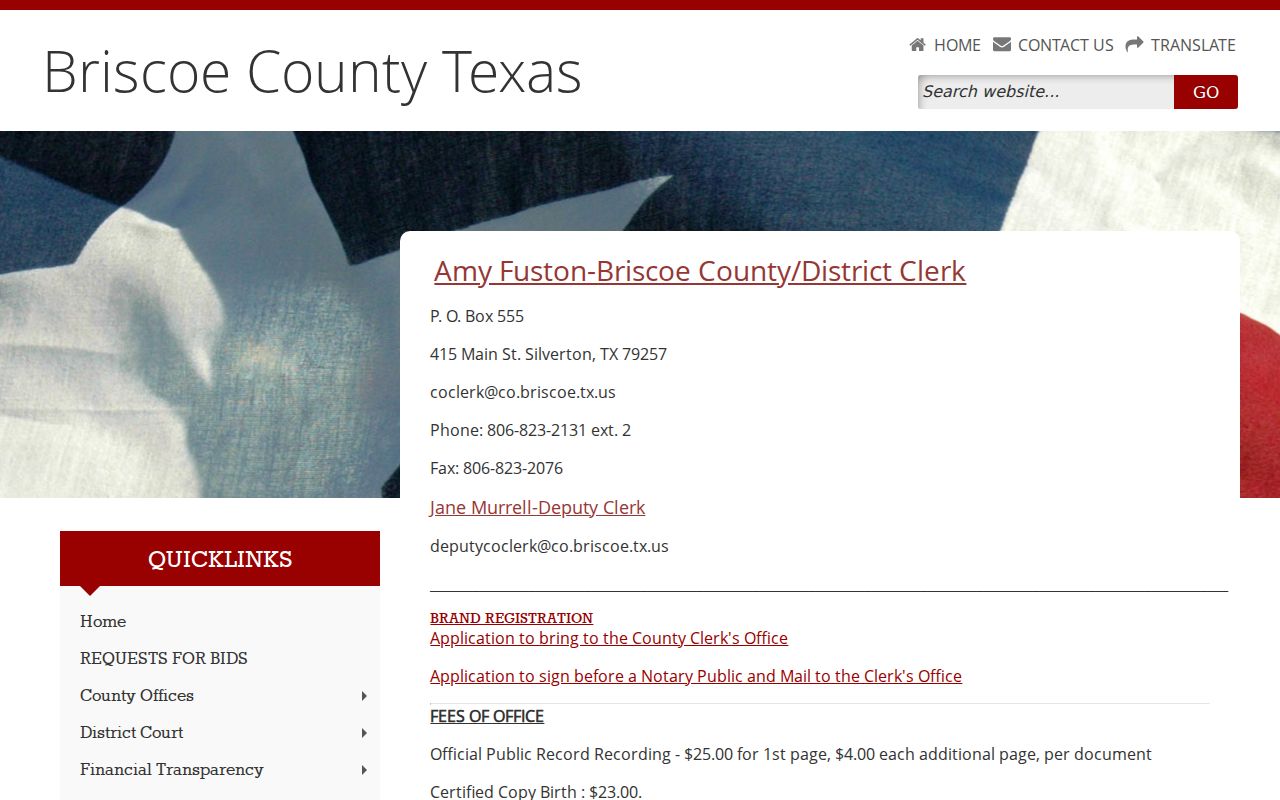
Briscoe County posts no live civil case-search form on its own pages. The stronger starting point is re:SearchTX. It offers Cases, Text in Documents, Hearings, and Filings searches for registered users. Even so, statewide coverage does not promise that every Briscoe civil file or image is there. For direct help, contact Briscoe County/District Clerk Amy Fuston. The office sits at 415 Main Street, Silverton, with mail to P.O. Box 555, Silverton, TX 79257. Reach the office by phone at (806) 823-2131 ext. 2. You can also fax (806) 823-2076 or email coclerk@co.briscoe.tx.us. The clerk counter and a public terminal, described in the 2019 archive plan, both allow in-person lookup of court records. Smaller claims may sit with a JP office instead.
- Identify the court level and collect the cause number or exact party caption.
- Search re:SearchTX with a narrow date range and the civil case type.
- Open the case detail and distinguish the docket entry from its filed document.
- Contact the combined clerk or correct JP if no complete record appears.
- Request the docket sheet and only the pleadings, orders, or judgment needed.
Where Briscoe Civil Cases Sit
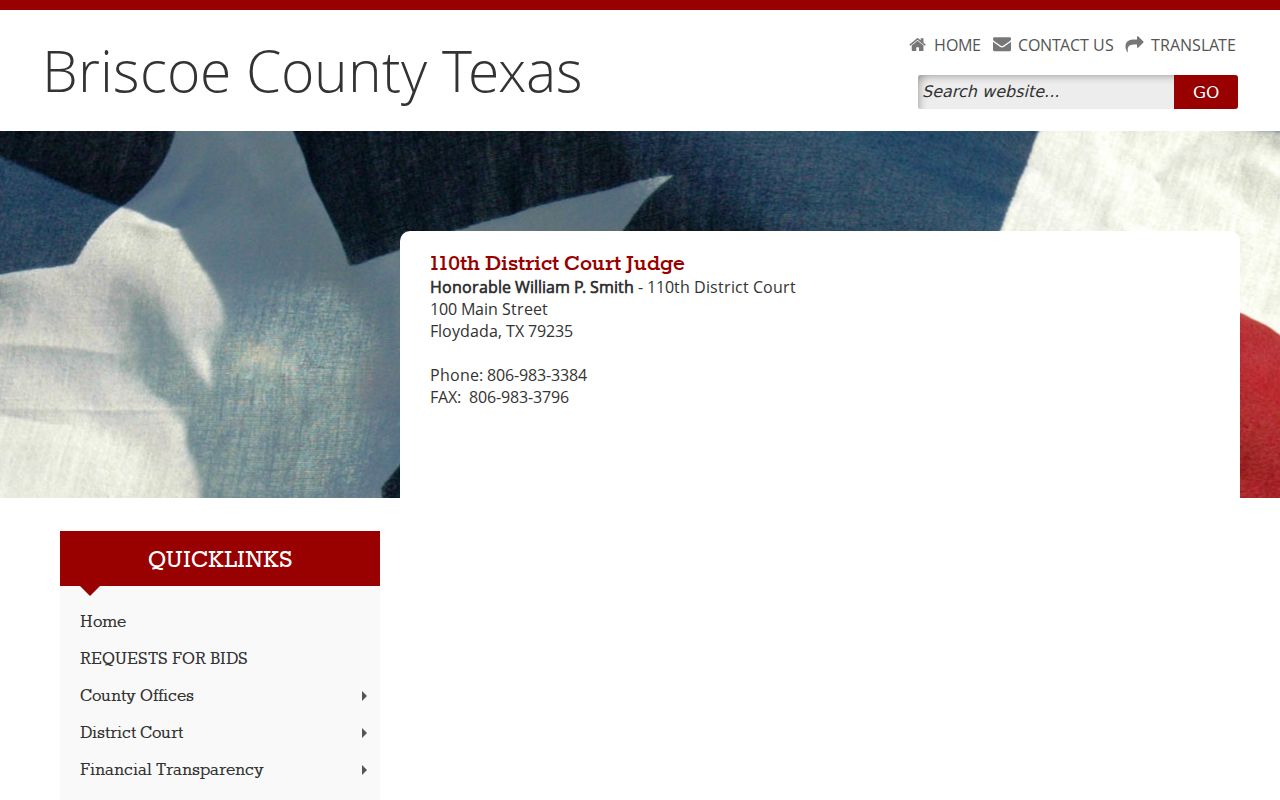
Civil cases split by level in Briscoe County. The 110th District Court handles major civil matters. It is classified for civil, family, criminal, and child-protection work. Briscoe County Court covers county-level civil, family, probate, and juvenile functions. Justice courts take the smaller disputes. These include small claims, eviction, and debt claims under current law. The official 110th District Court page shows the court's contact details. It lists Floydada as the primary location even though Briscoe filings route through the local combined clerk.
Confirm any hearing venue rather than assuming it. A case filed for Briscoe County does not guarantee that every setting happens at the Silverton courthouse.
Inside a Briscoe County Civil Docket
Think of a civil docket as an event register, not the whole file. It shows what was filed and when the court acted. No live Briscoe sample circulates, so treat the common components below as items to request and verify with the clerk.
| Cause number | The identifier assigned by the receiving court. |
|---|---|
| Style or caption | The names used by the court for the parties. |
| Pleadings | The petition, answer, amended pleadings, and public exhibits. |
| Motions | Requests made to the court and related ruling entries. |
| Settings | Scheduled hearings, trials, resets, or other appearances. |
| Outcome | An order, judgment, dismissal, or other disposition. |
A filing stamp confirms receipt; an order records a court action. The docket can list either without showing the full document. Once you find the entry, ask for the images or copies you need.
Briscoe Civil Records Public Terminal
The 2019 county archive plan is the clearest local word on court-record access. It notes that the County/District Clerk kept a public terminal. That terminal covered court documents and real-estate records. The same report covers electronic storage and daily off-site image backups. But it leaves out terminal hours, print options, remote access, staff help, and whether every older action file is indexed. The official combined clerk page carries the office and fee details.
Call before you drive over. Ask whether the cause number is indexed, whether the terminal can display the pleading, and whether a plain or certified copy can be made that day.
Civil Case Types on the Docket
Court level matters as much as subject. Land, title, contract, tort, and injunction cases tend to land in district court. Briscoe County Court can hear county-level civil matters within its statutory authority, while the JPs take the lower-dollar disputes.
- Contract, debt, title, property, tort, and injunction proceedings in the proper trial court.
- Small claims, debt claims, and eviction matters assigned to justice court.
- Divorce, custody, support, and protective-order matters, with access limits where required.
- Probate proceedings handled as a county-court function.
- Juvenile and child-protection matters that carry special confidentiality rules.
Family, probate, juvenile, and child-protection labels do not make every document public. Ask the clerk whether the specific docket sheet or filing is open, redacted, sealed, or restricted.
Briscoe Civil Docket Snapshot
Fiscal-year 2024 OCA statistics offer context, not names. The Briscoe district row listed 26 active civil cases pending at the start, 20 added, 5 disposed, and 41 active pending at the end. Family cases ran 24 at the start, 13 added, 12 disposed, and 25 active pending at the close.
These figures track court activity, not a searchable Briscoe County civil docket. No OCA report can name a party, filing, hearing, or outcome in one case. Use the numbers to gauge workload, then turn to the clerk for the actual file.
Civil Docket Settings and Hearings
A civil setting might involve a motion, scheduling issue, temporary relief, pretrial conference, bench trial, or jury trial. A setting is not a final hearing. A continuance does not end the case. Match the event label against the latest order or scheduling notice before you act on it. The Briscoe docket has no online calendar of its own. re:SearchTX includes a Hearings search, yet statewide coverage may not be complete or current for a local case, so confirm the date, time, judge, courtroom, setting type, and venue with the clerk. Keep in mind that the 110th District Court serves four counties and lists Floydada as its primary location. The Briscoe County court dates resource lays out the full confirmation chain.
Briscoe Civil Docket Terms
Four terms make any request easier to follow. They also help you separate the docket index from the papers stored behind it.
- Cause number
- The court’s unique identifier for a case.
- Petition
- The pleading that states the claimant’s requested relief.
- Answer
- A responding party’s filed reply to the petition.
- Order
- A written direction or ruling signed by the court.
Lead with the cause number whenever you have one. Party-name spelling can vary, but a number points the clerk to a single court file. Briscoe County publishes no confirmed civil cause-number pattern, so assume no prefix or sample format.
Civil Docket Access Rules
Texas Rule of Civil Procedure 76a starts from a simple idea. Court records are presumed open, and sealing them takes a strong showing. That presumption has limits, though. Some civil files stay restricted no matter what. Family records, child-protection files, juvenile material, protected probate information, and anything under a sealing order can all be withheld from a Briscoe County court docket search.
Rule 21c adds a duty to redact sensitive data before a civil filing becomes public. The list covers Social Security and tax numbers. It also covers driver's-license and passport numbers, financial-account numbers, birth dates, home addresses, and the name of anyone who was a minor when the suit began. Suppose a public docket image turns out to contain such data. Don't repost it. Request a corrected or redacted copy instead.
Key rules:
Texas Rule of Judicial Administration 12 covers judicial-record access and custodian duties.
Texas Rule of Civil Procedure 76a states the sealing standard for court records.
Texas Rule of Civil Procedure 21c addresses sensitive data in filed documents.
Ask for a Briscoe Civil Docket
A good records request names the right court from the start. That could be Briscoe County Court or the 110th District Court. JP Precinct 1 and JP Precinct 2 are options too. Then give the clerk something to work with. Include the cause number, the caption, a rough filing date, and a clear list of what you want. The docket sheet itself is a good place to begin. You can name specific pleadings, orders, or a judgment on top of it. Make clear you are asking for records that already exist. You are not requesting a new countywide report.
One legal wrinkle matters here. Chapter 552 of the Texas Government Code governs many administrative public-information requests. But judicial case records play by different rules, built on court procedures, statutes, and common law. So the clerk, not a public-information officer, is your first stop for a case file. If the clerk says no, push back politely. Ask what authority blocks access and whether a redacted copy could be released instead.
Costs are simple but not complete. Photocopies run $1 per page, per the clerk's list. No published schedule exists for certification, searches, postage, or electronic delivery. So request a quote before you order. One more catch: a transcript may sit with court reporter Terri Wyatt rather than the clerk. Describe the exact item you need so your request lands in the right hands.